
Track anyone or anything with the Google Geolocation API
How to use the Google Geolocation API to estimate device location based on cell tower and WiFi network signals when GPS is not available.

In 2021 a snowboarder from Singapore crossed the resort boundary at Whistler Blackcomb and disappeared into the backcountry. He uncharacteristically missed lunch with a friend, who immediately alerted Whistler Search and Rescue. The rescue team had little information about the man's whereabouts on the mountain, except for one detail: local police managed to ping his phone and get a "last location" at the top of Peak Chair. He was eventually found alive two days later on the backside of Whistler Mountain in an area known as the Cake Hole.
That cell tower ping is geolocation in action. In this post I'll explain how it works and show you how the Google Geolocation API uses the same technology to locate any device without GPS.
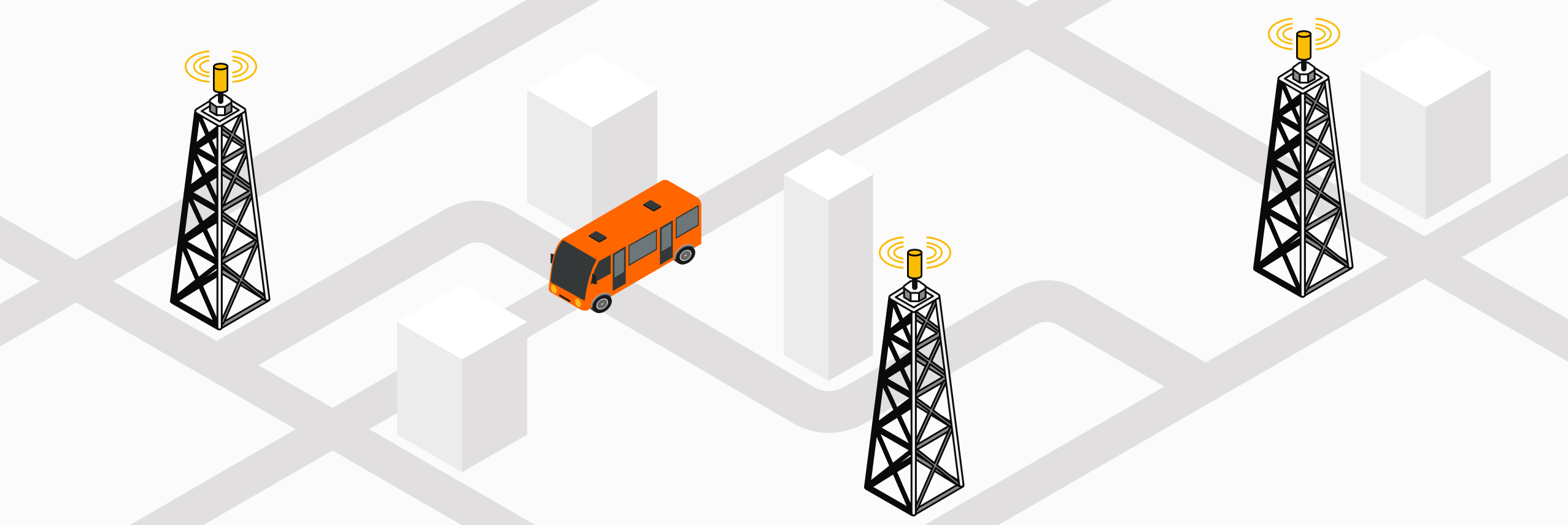
What is geolocation?
Geolocation is the process of estimating the geographic position of a person or device using signals from known infrastructure such as cell towers, WiFi access points or satellites. In the snowboarder example, police were able to find his last known location via cell phone triangulation. Every phone constantly registers with nearby cell towers as a byproduct of staying connected to the network. Each tower has a known fixed location. By measuring signal strength and timing across multiple towers, a device's position can be estimated. Here's a simplified example that shows how this works.
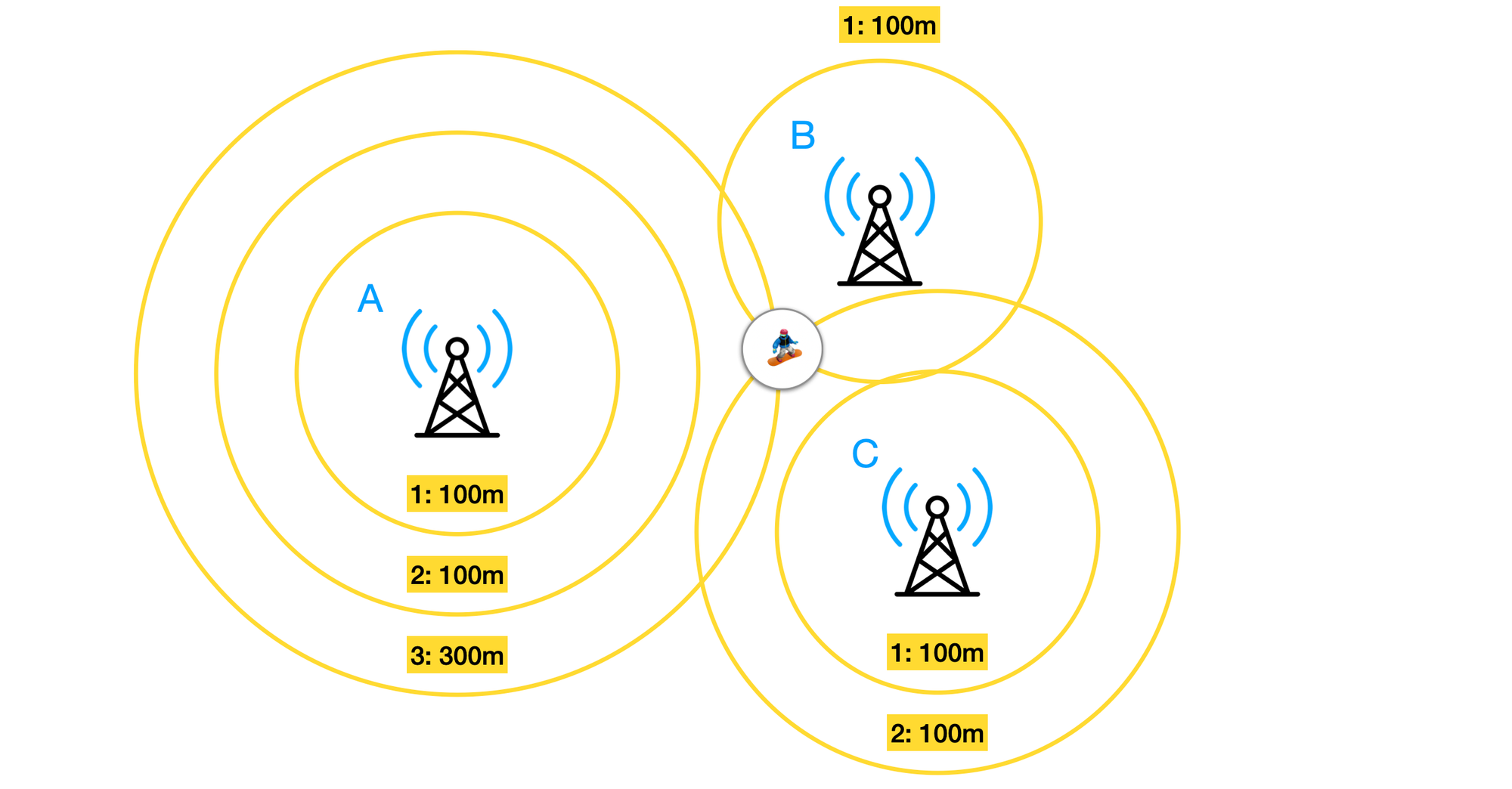
Suppose three cell towers - A, B, and C, that are within range of a device. Each tower broadcasts a continuous radio signal at a constant power level from a fixed, known location. As that signal travels outward, it weakens with distance. The device measures the received signal strength from each tower and uses those three readings to estimate how far it is from each one. For simplicity, assume there are three signal strength readings: strong (1), medium (2), and weak (3) - placing the device 100m, 200m, and 300m from the tower respectively.
One tower gives you a circle - the device is somewhere on its edge, but you don't know where. Two towers narrow it down to two possible points where those circles intersect. Three towers resolve the ambiguity completely. The device is at the single point where all three circles overlap (see the illustration above) hence the name for this method, triangulation.
What is the Google Geolocation API?
The Google Geolocation API is a location lookup service. Tell it which cell towers and WiFi access points your device can detect, along with their signal strengths, and it returns location coordinates along with an accuracy radius indicating how precise the estimate is.
How does the Google Geolocation API work?
Google has a massive database of every cell tower and WiFi access point in the world. Initially, this data was collected by Street View cars, which in addition to collecting road imagery, were also running network scanning equipment that passively recorded data from every WiFi access point and cell tower they drove past, logging the MAC address, signal strength, and GPS coordinates at that moment. Google had to stop this when they were sued by the US Federal Communications Commission (FCC) which eventually fined Google $25,000. This was followed by similar legal action in the UK, Australia and Canada.
But the data collection continued, this time with Android phones. When you carry an Android phone with location services on, it periodically does something called a network scan - it notes all the WiFi access points and cell towers visible around it, along with their Cell ID, LAC (Location Area Code), MCC (Mobile Country Code), MNC (Mobile Network Code) and signal strengths. If the phone also has a GPS fix at that moment, it records the GPS coordinates too. That data is sent back to Google. Every Android phone essentially became a mobile survey vehicle, and there are billions of them. This means that Google's network database updates in near real time as new network equipment gets added quickly after activation. This database covers places Street View cars never went - inside malls, hospitals, office buildings and private roads.
So when you send the Google Geolocation API a list of cell tower or WiFi access points your device is able to connect to, Google looks up each tower and access point in its database and matches your signal observations to known physical tower or access point locations. It then uses triangulation to figure out your device's location and returns latitude and longitude coordinates plus an accuracy radius in meters.
When would you use the Google Geolocation API?
The Google Geolocation API is ideal for internet connected devices that need location tracking but don't have a GPS chip, either because GPS hardware is too expensive at scale, or because the device will spend most of its time indoors where GPS doesn't work anyway. Think robot vacuum cleaners, smart home appliances, and asset trackers.
A hospital wheelchair tracker is a perfect example. Wheelchairs are expensive, frequently misplaced, and almost always indoors. GPS is useless inside a building. But as long as the tracker can reach the hospital's WiFi network, it can call the Geolocation API to estimate its position using nearby access points - no GPS chip required.
What data does the Google Geolocation API need?
To call the Google Geolocation API we need two things: a way to collect signal data, and a way to connect to the internet to send it.
To collect signal data, your device needs a cellular modem that can scan nearby cell towers or a WiFi chip to scan nearby access points. Either works, and combining both gives better accuracy. Neither needs an active data plan just to scan because the towers and access points broadcast their identifiers continuously and any radio chip in range can detect them.
For the purposes of this blog post, we'll be using the free Android app Network Cell Info Lite to simulate a cellular modem. It reads and displays the raw cell tower data that your phone sees (and is silently collected by Android in the background) but never shows you.
- Download the app from the Google Play Store.
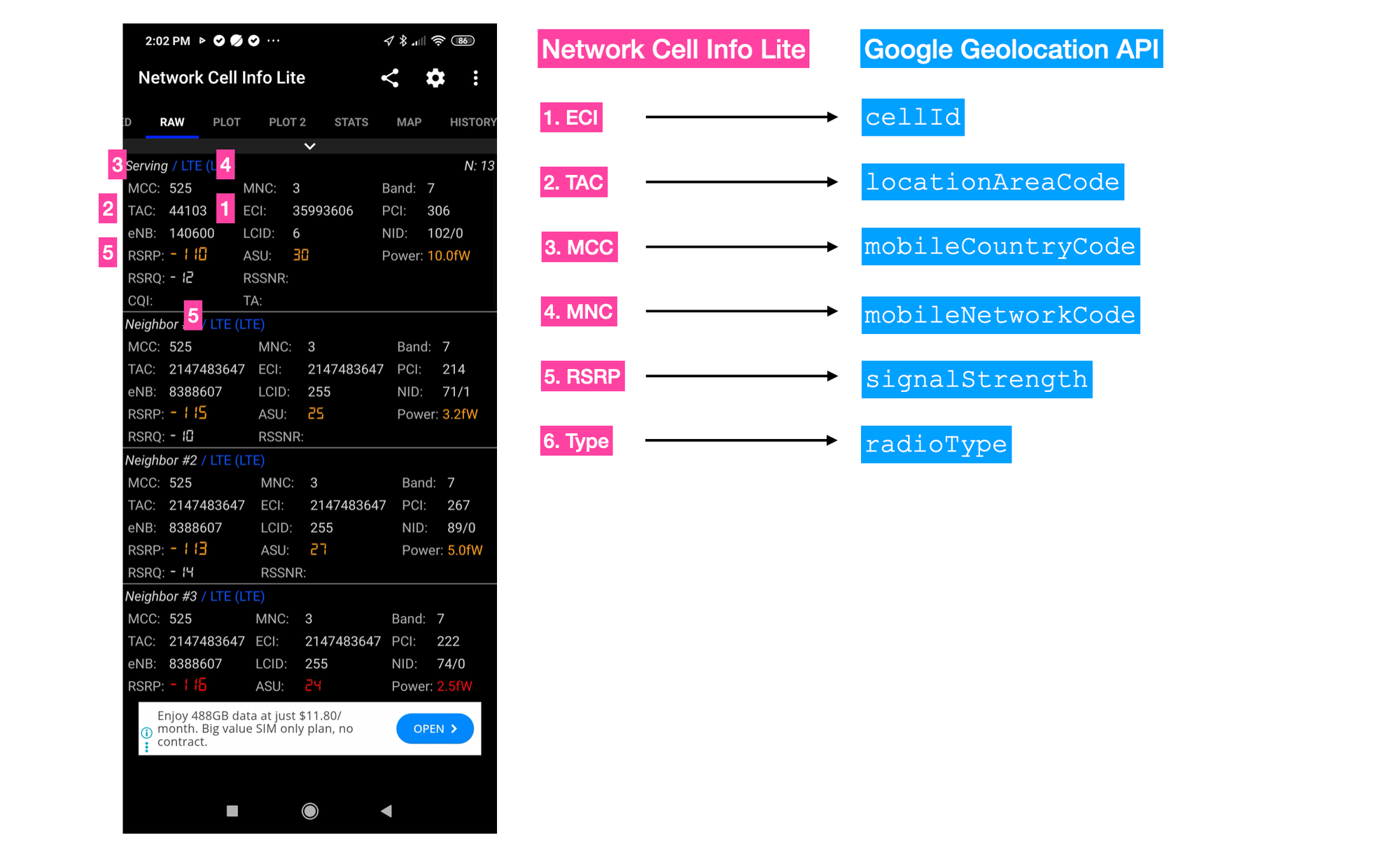
- Open the app and navigate to the Raw tab and take note of the following fields: ECI (Evolved Cell Identifier), TAC (Tracking Area Code), MCC (Mobile Country Code), MNC (Mobile Network Code), RSRP (Reference Signal Received Power) and network type (LTE, 3G, 2G etc).
- Switch to the Device + Sim tab and do the same for the operator field.
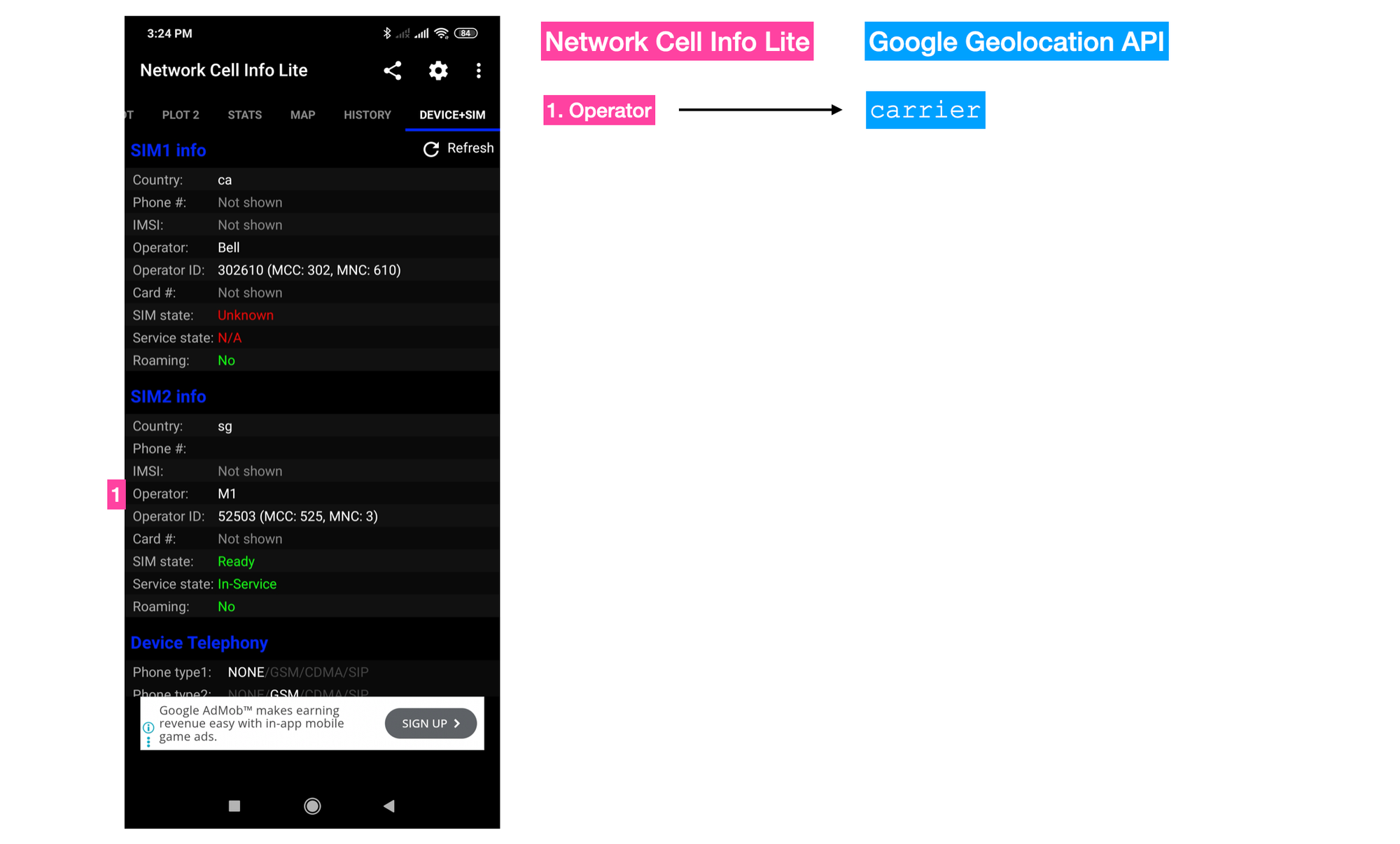
The screenshots above show Network Cell Info Lite on the left and the corresponding Google Geolocation API request fields on the right. Each value from the app maps directly to a field in the API.
Google Geolocation API worked example
Here's a simple example of me calling the Google Geolocation API from my home in Singapore.
Endpoint: POST
https://www.googleapis.com/geolocation/v1/geolocate?key={YOUR_API_KEY}
&Content-Type=application/json
{YOUR_API_KEY} is your Google Maps API key with the Google Geolocation API enabled.
Body
{
  "homeMobileCountryCode": 525,
  "homeMobileNetworkCode": 3,
  "radioType": "lte",
  "carrier": "M1",
  "cellTowers": [
    {
      "cellId": 35993606,
      "locationAreaCode": 44103,
      "mobileCountryCode": 525,
      "mobileNetworkCode": 3,
      "age": 0,
      "signalStrength": -110,
      "timingAdvance": 0
    },
    // ... 2 - 3 cellTower objects if available
  ]
}
homeMobileCountryCode is the Mobile Country Code (MCC) for the device's home network. See the full list here.
homeMobileNetworkCode is the Mobile Network Code (MNC) for the device's home network. Each carrier has a unique MNC per country (search for yours here). It's always a number 0 - 999.
radioType is the mobile radio type. Supported values are gsm, cdma, wcdma, lte and nr.
carrier is the name of your carrier (phone company).
cellTowers is an array of cell tower objects:
{
      "cellId": 35993606,
      "locationAreaCode": 44103,
      "mobileCountryCode": 525,
      "mobileNetworkCode": 3,
      "age": 0,
      "signalStrength": -110,
      "timingAdvance": 0
}
cellId (required) is the unique identifier of the cell tower you are connecting to. LTE (4G) networks use the E-UTRAN Cell Identity (ECI) which has a valid range: 0 - 268435455.
locationAreaCode (required) is also known as the Tracking Area Code (TAC) for LTE networks. Has a valid range of 0 - 65535.
mobileCountryCode (required) is the cell tower's Mobile Country Code (MCC). Valid range: 0 - 999.
mobileNetworkCode (required) is the cell tower's Mobile Network Code (MNC). The valid range for MNC is 0 - 999.
signalStrength is how strong the signal is from each tower or access point, measured in dBm - a negative number. -65 to -75 is excellent, -75 to -85 is good, and anything below -110 is very poor.
age (the number of milliseconds since the device connected to the network) and timingAdvance (a measurement of how far your device is from the cell tower it's connected to expressed as a time delay rather than a distance) can be ignored.
Response
{
    "location": {
        "lat": 1.2960349,
        "lng": 103.8164533
    },
    "accuracy": 270.382
}
location is the device's estimated latitude and longitude coordinates, in degrees.
accuracy is the accuracy of the estimated location, in meters. This represents the radius of a circle around the given location.
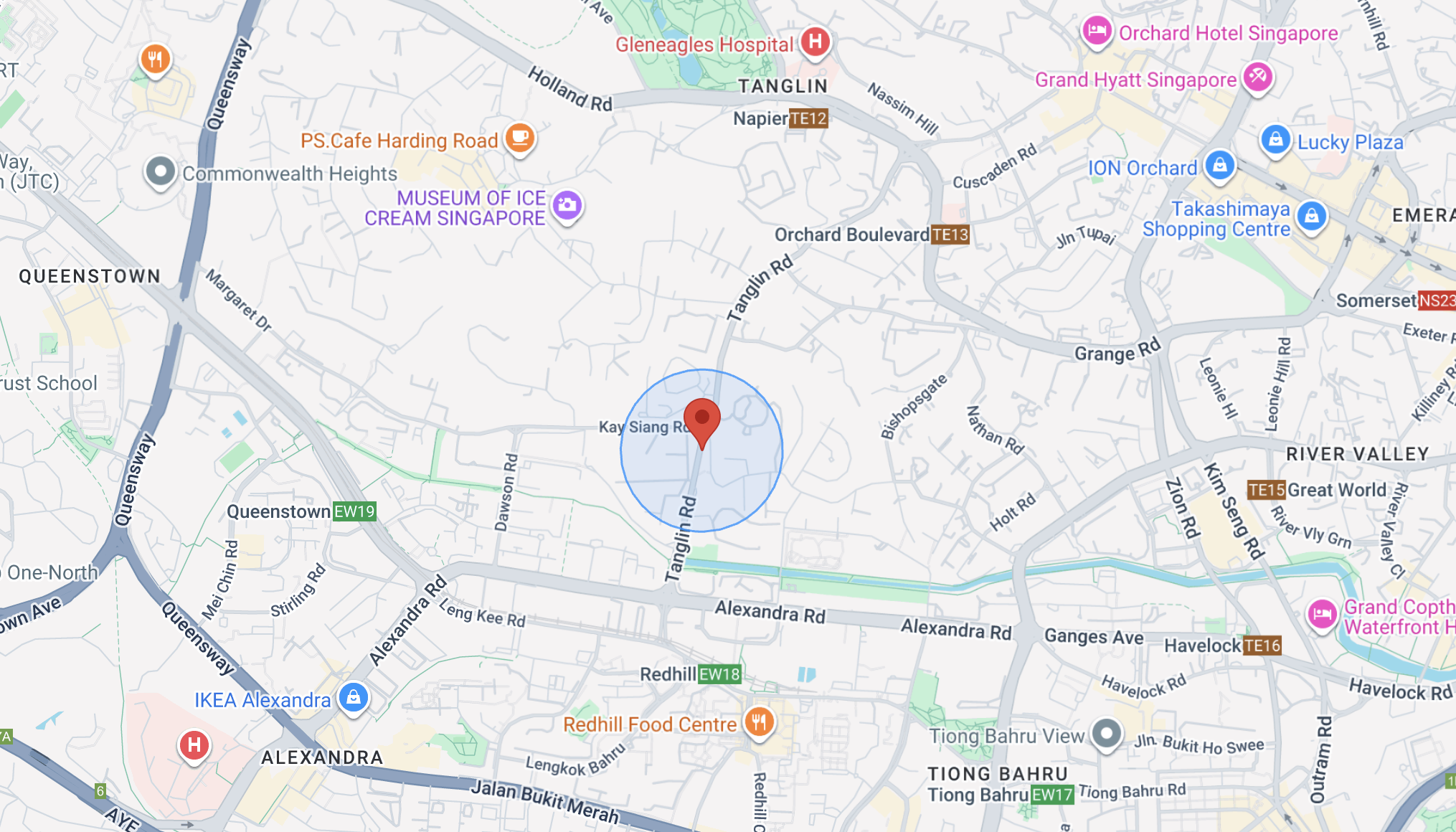
The API returned a location close to my actual position, but with an accuracy radius of 270m - meaning the device could be anywhere within a 270 meter radius. That's too imprecise for most tracking applications, especially when alternatives like Apple AirTags can locate a device to within a few meters for under $30.
Note: You can get more accurate results if you include a list of WiFi access points like so:
{
  "wifiAccessPoints": [
    {
      "macAddress": "80:69:1a:39:26:33",
      "signalStrength": -43,
      "channel": 13
    },
    {
      "macAddress": "fc:12:63:36:1:54",
      "signalStrength": -56,
      "channel": 11
    }
  ]
}
WiFi data can improve accuracy to 15 - 40 meters in most urban environments, but only if Google's database has already mapped your nearby access points. Mine hadn't been mapped yet because I'd reset my router a few weeks earlier, assigning it a new MAC address. New MAC addresses don't appear in Google's database until an Android device with location services passes by and logs them.
Google Geolocation API pricing
Like other Google Maps Platform APIs, the Elevation API follows a pay-as-you-go pricing model, with volume discounts that lower the cost as your usage increases. Pricing starts at $5.00 CPM (cost per thousand) and there's a free usage cap of 5,000 API calls per month.
| 0 - 10k | 10k - 100k | 100k - 500k | 500k - 1M | 1M - 5M | 5M+ | |
|---|---|---|---|---|---|---|
| Time Zone API | FREE | $5.00 | $4.00 | $3.00 | $1.50 | $0.38 |
- what is geolocation?
- what is the Google Geolocation API?
- when would you use the Google Geolocation API?
- how does the Google Geolocation API work?
- how do you get the data needed for the Google Geolocation API to work?
- Google Geolocation API example
- Google Geolocation API pricing
The API works well in exactly the environments it was designed for — dense urban areas with lots of mapped WiFi infrastructure. It degrades significantly everywhere else, and does so in a way that isn't always obvious from the response unless you're checking the accuracy radius carefully.
One of the most concrete real-world examples comes from a developer forum thread that ran from 2023 into 2025. A user reported that their device's location was frequently incorrect across all browsers — Google Maps was showing them in Germany when they were actually in the US. Another user in the same thread reported the same issue specifically after switching to a T-Mobile 5G tower, with Google Maps placing them in Chicago when they were in west Michigan. Arch Linux Forums
The user discovered that switching Firefox's geolocation provider from Google's API to Mozilla Location Services changed the reported location — but switching back to Google's API didn't restore the original wrong location, suggesting the problem was a stale cached entry in Google's database rather than a live lookup issue. Arch Linux Forums
This is the stale database problem in action. A new 5G tower gets assigned a Cell ID that Google's database either doesn't recognise yet, or associates with a previous tower that occupied that ID in a different location.
6. Indoor Accuracy Degradation
Even in dense urban environments with good WiFi coverage, accuracy degrades significantly indoors in specific situations:
- Buildings with no WiFi or only a single access point
- Basement levels where cell signal is weak
- Environments with many temporary or mobile WiFi hotspots — coffee shops, events — that aren't in Google's database yet or have moved
7. The Singapore-Specific Context
Since you're in Singapore, worth noting that Singapore generally gets good results from the Geolocation API because:
- Very high density of cell towers and WiFi access points
- High Android device penetration means Google's crowdsourced database is dense and frequently updated
- Small geographic area means even a large accuracy radius still places you somewhere recognisable
The most commonly reported accuracy issues in Singapore tend to be in underground MRT stations and basement carparks — exactly the environments where cell signal is weakest and WiFi mapping may be incomplete.
What Google Says About It
Google's own documentation acknowledges the accuracy limitations fairly explicitly. They state that:
- WiFi with multiple access points typically returns accuracy of around 20 meters
- Cell tower accuracy varies from hundreds of meters to several kilometres depending on tower density
- IP geolocation accuracy can be in the range of thousands of meters
The complaints that have the most traction on Google's issue tracker are the stale database entries — where a small accuracy radius implies confidence but the location is still significantly wrong. That's the one case where the API is genuinely misleading rather than just imprecise.
home | number (uint32) | The mobile country code (MCC) for the device's home network. | Supported for radio gsm (default), wcdma, lte and nr; not used for cdma.Valid range: 0–999. |
home | number (uint32) | The Mobile Network Code for the device's home network. This is the MNC for GSM, WCDMA, LTE and NR. CDMA uses the System ID (SID) | Valid range for MNC: 0–999. Valid range for SID: 0–32767. |
radio | string | The mobile radio type. Supported values are gsm, cdma, wcdma, lte and nr. | While this field is optional, it should always be included if the radio type is known by the client. If the field is omitted, Geolocation API defaults to gsm, which will result in invalid or zero results if the assumed radio type is incorrect. |
carrier | string | The carrier name. | |
consider | boolean | Specifies whether to fall back to IP geolocation if WiFi and cell tower signals are missing, empty, or not sufficient to estimate device location. | Defaults to true. Set consider to false to prevent fall back. |
cell | array | An array of cell tower objects. | See the Cell Tower Objects section below. |
wifi | array | An array of WiFi access point objects. | See the WiFi Access Point Objects section below. |
Cell tower objects
The request body's cellTowers array contains zero or more cell tower objects.
| Field | JSON type | Description | Notes |
|---|---|---|---|
cell | number (uint32) | Unique identifier of the cell. | Required for radio gsm (default), cdma, wcdma and lte; rejected for nr.See the Calculating cellId section below, which also lists the valid value ranges for each radio type. |
new | number (uint64) | Unique identifier of the NR (5G) cell. | Required for radio nr; rejected for other types.See the Calculating newRadioCellId section below, which also lists the valid value range for the field. |
location | number (uint32) | The Location Area Code (LAC) for GSM and WCDMA networks. The Network ID (NID) for CDMA networks. The Tracking Area Code (TAC) for LTE and NR networks. | Required for radio gsm (default) and cdma, optional for other values.Valid range with gsm, cdma, wcdma and lte: 0–65535.Valid range with nr: 0–16777215. |
mobile | number (uint32) | The cell tower's Mobile Country Code (MCC). | Required for radio gsm (default), wcdma, lte and nr; not used for cdma.Valid range: 0–999. |
mobile | number (uint32) | The cell tower's Mobile Network Code. This is the MNC for GSM, WCDMA, LTE and NR. CDMA uses the System ID (SID). | Required. Valid range for MNC: 0–999. Valid range for SID: 0–32767. |
WiFi access point objects
The request body's wifiAccessPoints array must contain two or more WiFi access point objects representing physically distinct stationary access point devices. The macAddress field is required. All other fields are optional. The service ignores access points that move, such as those in airplanes and trains.
| Field | JSON type | Description | Notes |
|---|---|---|---|
mac | string | The MAC address of the WiFi node. It's typically called a BSS, BSSID or MAC address. | Required.Colon-separated (:) hexadecimal string.Only universally-administered MAC addresses can be located using the API. Other MAC addresses are silently dropped and may lead to an API request becoming effectively empty. For details, see Dropping useless Wifi access points. |
signal | number (double) | The current signal strength measured in dBm. | For WiFi access points, dBm values are typically -35 or lower and range from -128 to -10 dBm. Be sure to include the minus sign. For values greater than -10 dBm, the API returns NOT FOUND. |
age | number (uint32) | The number of milliseconds since this access point was detected. | |
channel | number (uint32) | The channel over which the client is communicating with the access point. | |
signal | number (double) | The current signal to noise ratio measured in dB. |
asdasd
{
  "homeMobileCountryCode": 525,
  "homeMobileNetworkCode": 3,
  "radioType": "lte",
  "carrier": "M1",
  "cellTowers": [
    {
      "cellId": 35993606,
      "locationAreaCode": 44103,
      "mobileCountryCode": 525,
      "mobileNetworkCode": 3,
      "age": 0,
      "signalStrength": -110,
      "timingAdvance": 0
    },
    {
      "cellId": 2147483647,
      "locationAreaCode": 2147483647,
      "mobileCountryCode": 525,
      "mobileNetworkCode": 3,
      "age": 0,
      "signalStrength": -115,
      "timingAdvance": 0
    }
  ]
}